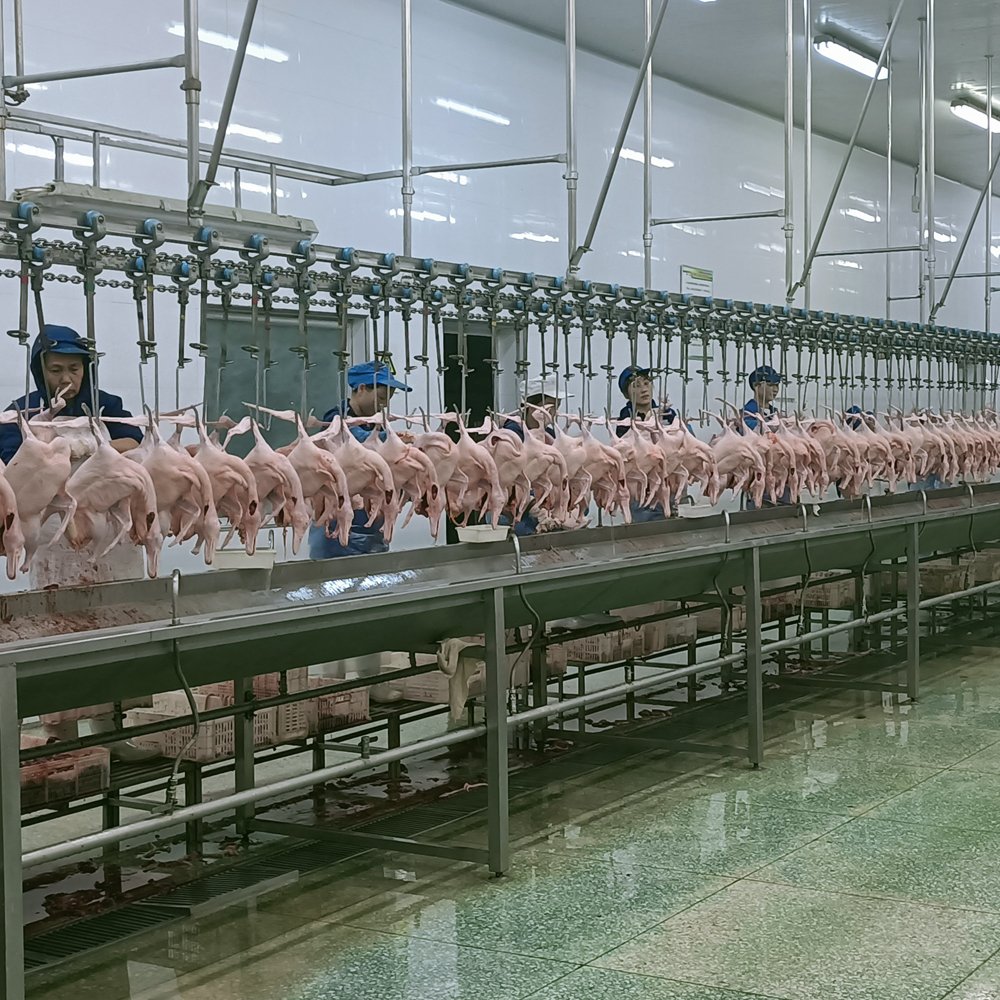
The slaughtering process requirements for broilers and ducks may vary slightly depending on regional regulations and factory scale, but the core engineering principles remain the same. Whether you are upgrading an existing facility or building a new 4000bph poultry slaughter line, mastering these basic technologies is critical to maximizing meat yield and plant efficiency.
A standard broiler slaughtering and processing flow is mainly divided into four critical phases: Slaughtering & Depilation, Evisceration, Pre-cooling, and Segmentation & Packaging.
Here is the step-by-step technological breakdown from a professional equipment manufacturer’s perspective.
Phase 1: Broiler Slaughtering and Depilation Area (Scalding & Plucking)
The pre-treatment area covers the process from unloading live birds to complete feather removal.
- Live Bird Handling & Stunning: Broilers arrive in plastic crates (usually 8-10 birds per crate). Workers hang the chickens on the overhead conveyor chain. To maintain efficiency, the line speed should match a labor intensity of 1200-1500 birds per person, per hour. The birds then pass through a dark calming passage for 30-40 seconds to reduce struggling before entering the electric water-bath stunner.
- Bleeding: After slaughter, the blood draining time must be strictly controlled between 4.5 to 5.5 minutes. If the time is too short, poor bleeding affects meat quality; if too long, the carcass loses weight and makes feather removal difficult.
- Scalding Technology: After bleeding, the chicken is transported to the poultry scalding machine. As a critical component of any high-efficiency processing line, the scalding equipment dictates the final skin and meat quality. We strongly recommend the air-blowing type over the water-lifting type to prevent chickens from floating, ensuring an even scald. The temperature difference inside the scalding pool must not exceed 0.5°C.
- Feather Removal (Plucking): Immediately after scalding, birds enter the plucking machines. A 35-40°C hot water spray is applied for lubrication. For medium to large plants, separating the process into coarse and fine feather removal machines is highly recommended to prevent wing or claw damage.
Phase 2: Evisceration Area & Internal Cleaning
The evisceration area is where the internal organs, head, and neck skin are removed.
The typical flow includes: picking small hairs → pulling the head → cutting the neck skin → opening the cavity → removing viscera → separating liver/gizzard/intestines → internal and external washing.
Expert Tip: It is essential to continuously rinse the chicken body during these steps to maintain hygiene and keep the carcass moist. While manual evisceration is common in smaller plants to save costs, investing in automatic internal and external bird washers significantly improves your HACCP compliance.
💡 [View Our Complete Turnkey Poultry Processing Line Solutions]
Phase 3: Pre-cooling Area (Spiral Chiller Systems)
Pre-cooling is mandatory to halt bacterial growth and preserve shelf life. The automated chicken unloader drops the eviscerated carcasses directly into the chilling system.
While traditional pool chilling (using refrigeration pipes in a rectangular pool) offers low operating costs, modern export-standard slaughterhouses prefer Spiral Precoolers. Spiral chillers are far superior for sanitary cleaning and continuous production. The total chilling time must be guaranteed at 35-40 minutes, split into two stages. The addition of industrial flake ice makers is necessary to maintain the second-stage water temperature at 0-2°C, ensuring the core temperature of the carcass drops below 8°C.
Phase 4: Cutting and Packaging Area
The final phase takes place in a temperature-controlled room (strictly below 16°C).
Pre-cooled carcasses are hung on the cutting line or placed on a V-belt conveyor for portioning. The standard cutting sequence involves removing the tail, wings, back, breast, and legs. The subdivided products are then manually selected, weighed, and vacuum-packaged according to your local market demands.
Frequently Asked Questions (FAQ): Core Technical Parameters
To help you configure your equipment correctly, here are the exact engineering parameters our factory uses when designing commercial slaughter lines:
Q: What are the standard electrical stunning parameters for broilers?
A: To ensure proper anesthesia without cardiac arrest, the voltage should be set between 35-60V (AC or DC). The current passing through each bird must be 18-20mA, with a stunning duration of 8-10 seconds.
Q: What is the optimal scalding time and temperature?
A: To achieve perfect feather removal without blanching the valuable breast meat, the optimal scalding time is 75-85 seconds at a highly stable water temperature of 57.5-60°C.
Q: What are the best mechanical settings for poultry plucking machines?
A: For optimal performance, the swing plate speed of the coarse feather removal machine should be around 950 r/min, while the fine feather removal machine operates best at 750 r/min. The rubber plucking fingers (glue sticks) must have a hardness of Shore A40-50.
Q: How cold should the water be in the poultry spiral precooler?
A: The precooling process should last 40 minutes. It is critical to maintain the final stage chilling water temperature between 0-2°C so the core meat temperature safely reaches below 8°C.