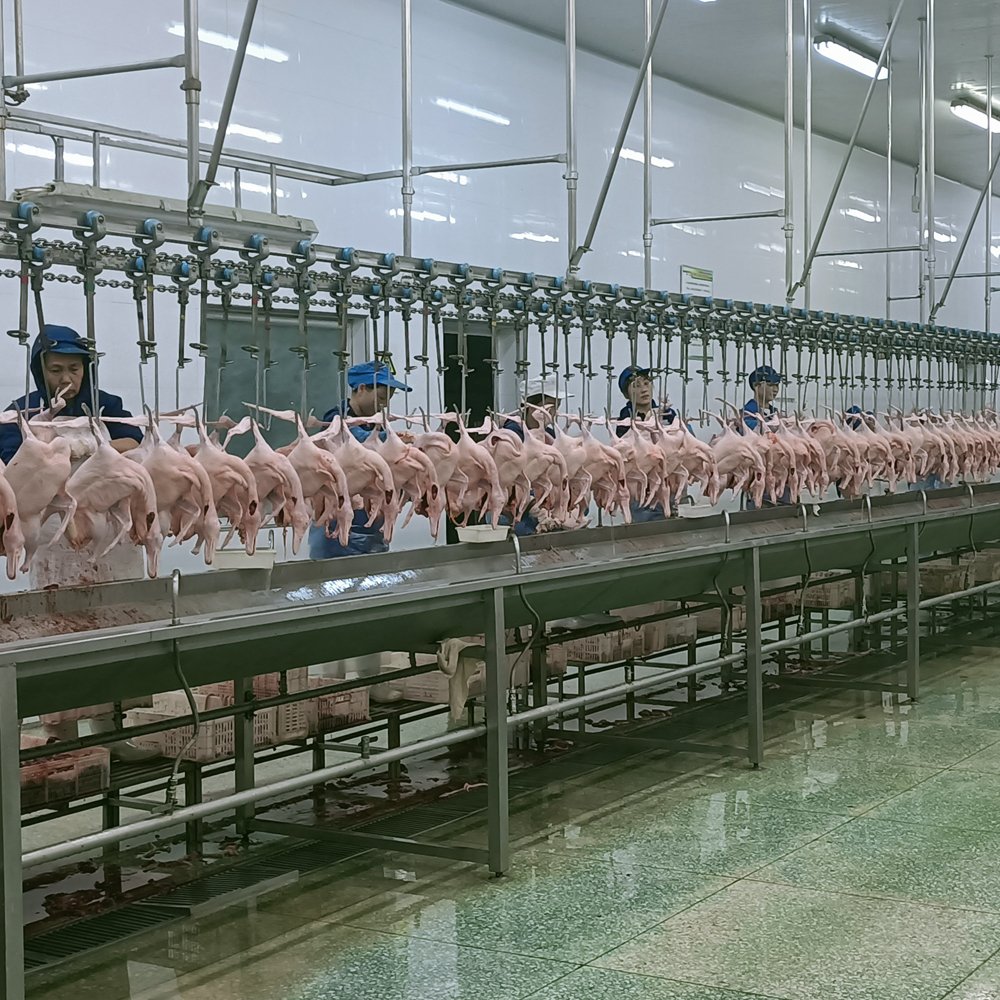
The slaughtering process requirements of broilers and ducks vary slightly depending on the region and manufacturer, but the basic process is the same. The following are the basic slaughtering process requirements for chickens and ducks:
The process flow of broiler slaughtering and processing is mainly divided into 4 areas, namely, the slaughtering and depilation area, the evisceration area, the pre-cooling area and the segmentation and packaging area. The process flow is as follows: hanging feather chickens → calming → (electric anesthesia) → slaughtering → bleeding → scalding → depilation → cleaning → pre-cooling → segmentation → packaging.
- Slaughtering and depilation area
The slaughtering and depilation area refers to the processing area from the time when broilers are unloaded from the chicken transport vehicle to the time when the feathers are cleaned. The process flow is as follows: cage separation → hanging chickens → calming → (electric anesthesia) → slaughtering → bleeding → bleeding → scalding → depilation → claw cutting (hanging down). For small and medium-sized broiler slaughterhouses, cage separation machines are not required. Broilers are usually packed in plastic baskets, stacked into 7 cages and delivered to the slaughterhouse by car, with 8-10 chickens in each basket. The cage sorting machine is to separate the chickens in a pile of 7 cages into cages and transport them to the poultry cage conveyor belt. The chicken hanging personnel hang the chickens from the running chicken cages to the assembly line chain, and the labor intensity should generally be arranged according to 1200-1500 chickens per person per hour.
After the chickens are hung on the hooks, they should run in a dark passage for 30-40 seconds to calm the live chickens and reduce their struggles. After 10 seconds, electric anesthesia is performed. The intensity of electric anesthesia should ensure that the current passing through each chicken body is 18-20mA, the electric anesthesia time is 8-10s, and the voltage is usually between 35-60V. Either AC or DC can be used.
The blood draining time after slaughter is 4.5-5.5min. If the blood draining time is too short, the blood will not be drained cleanly, affecting the quality of the chicken; if the time is too long, it is not good for hair removal, and it will cause weight loss and reduce the meat yield. After blood draining, the chicken body is transported to the scalding machine. The scalding machine and the depilator are both key equipment in the pre-treatment area. The scalding effect directly affects the quality of the chicken. The requirements for the scalding machine are mainly to ensure the uniformity of the scalding time, scalding temperature and water temperature in the scalding pool. The temperature difference of the water in the scalding pool should not be greater than 0.5°C. The water turning condition in the scalding pool also has a great influence on the scalding effect. There are currently two stirring methods, namely the water lifting type and the air blowing type.
From the observation and investigation of various manufacturers, the air blowing type is better than the water lifting type. The water lifting type usually has the phenomenon of floating chicken and falling chicken. The floating chicken directly affects the scalding permeability of the chicken back, resulting in the phenomenon of incomplete removal of yellow skin and small hair. In order to remove yellow skin and small hair, the scalding temperature often has to be increased, but after increasing the temperature, the breast meat will be blanched, which is not allowed. The location of the defeathering machine should be close to the scalding machine. The chicken body should enter the defeathering machine immediately after scalding. An appropriate amount of hot water should be sprayed on the top of the defeathering machine to lubricate the skin and chicken body. The water temperature is preferably 35-40°C. In order to remove the small hair and yellow skin on the chicken body, it is particularly important to ensure sufficient feather removal time, which should usually be guaranteed to be more than 30 seconds. For medium and large broiler slaughterhouses, coarse and fine feather removal machines should be equipped.
The speed of the pulley of the feather removal machine also affects the quality of feather removal. If the speed is too fast, the impact of the feather removal rod on the chicken body will increase, which is easy to damage the chicken body and cause broken wings and claws. The speed of the swing plate is too slow, which is not conducive to feather removal. After years of practical exploration, the swing plate speed of the coarse feather removal machine is preferably around 950r/min, and the swing plate speed of the fine feather removal machine is preferably 750r/min. The hardness of the glue stick also has a direct impact on the feather removal effect. The hardness of the glue stick is usually taken as Shore A45-50. In order to remove the hair on the chicken head, a scalding tank is usually connected after the first feather removal machine or the scalding machine. The length of the scalding tank is preferably enough to allow the chicken head to be scalded for 3-5s, and the temperature is about 70°C. After the hair is removed, the chicken body is automatically clawed by the claw cutting machine, and the chicken body after claw cutting flows into the middle plucking area. Some manufacturers use manual claw cutting to ensure the quality of chicken feet. - Evisceration area
The evisceration area refers to the area where the evisceration, head, and neck skin of the plucked chicken are removed and cleaned. The process flow is as follows: hanging up → picking small hairs → pulling the head → picking the crop → cutting the crop → cutting the neck skin → opening the cavity → removing the viscera → separating the liver → separating the gizzards → picking the spleen → pulling the intestines → removing the cavity → pulling the oil → cutting the chest bursa → cleaning inside and outside → hanging down. For the evisceration area, it should be noted that the chicken body should be rinsed frequently to keep the chicken body hygienic and moist. External sprayers can be arranged between several processes. Among them, the head pulling and head cutting processes can be completed with a head removal machine. If the chicken body and outside cleaning machine are not installed, 4 people need to be arranged for internal cleaning. After the chicken body is eviscerated, the head and neck skin are removed and cleaned, the automatic chicken unloader will automatically drop the chicken body into the pre-cooling area. - Precooling area
The precooling area refers to the area where the chicken bodies from the middle pulling area are disinfected and cooled. There are usually two precooling methods, namely precooling pool type and precooling machine type. Most of the early electric slaughter plants used pool precooling, that is, some refrigeration pipes were arranged in a rectangular pool, and the chicken bodies entered the pool through the catenary system and ran in the pool for about 40 minutes. Its characteristics are good precooling effect and low operating cost, but it is not conducive to sanitary cleaning. In recent years, most of the newly built electric slaughter plants use spiral precoolers. Although the operating cost is slightly higher than pool precooling, it is convenient for sanitary cleaning and is conducive to ensuring the quality of chicken. The precooling time should also be guaranteed to be 35-40 minutes. Regardless of the method used, it is divided into two stages of precooling. The water temperature in the first stage can be slightly higher, and the water temperature in the second stage should be maintained at 0-4°C. Only in this way can the temperature of the chicken body after precooling be no higher than 8°C. The use of spiral precoolers must be equipped with ice makers. - Cutting and packaging area
The cutting and packaging area refers to the area where the pre-cooled chicken body is divided into several products and packaged. The temperature of the cutting and packaging area is below 16°C. The process flow is as follows: hang the chicken → cut the chicken tail → cut the two sides → cut the back → cut the breast wings → scrape the small meat → larynx → cut the soft muscle bone → cut the leg → cut the long skin → cut the neck → remove the neck. After the chicken legs and breast wings are cut off, they are placed on the V-belt conveyor for manual rough cutting, and then sent to the workbench for fine cutting and packaging after selection. The subdivided products are mainly determined according to market needs.
In summary, the main technical parameters of broiler slaughtering and processing are as follows:
Electric anesthesia: voltage 35-60V time 8-10s current 18-20mA/piece
Blood draining time: 4.5-5.5min
Scalding time: 75-85s
Scalding temperature: 57.5-60°C
Feather removal time: 30-40s
Rate of coarse feather removal machine: 950r/min
Rate of fine feather removal machine: 750r/min
Glue stick hardness: Shore A40-50
Precooling: time 40min; water temperature: 0-2°C